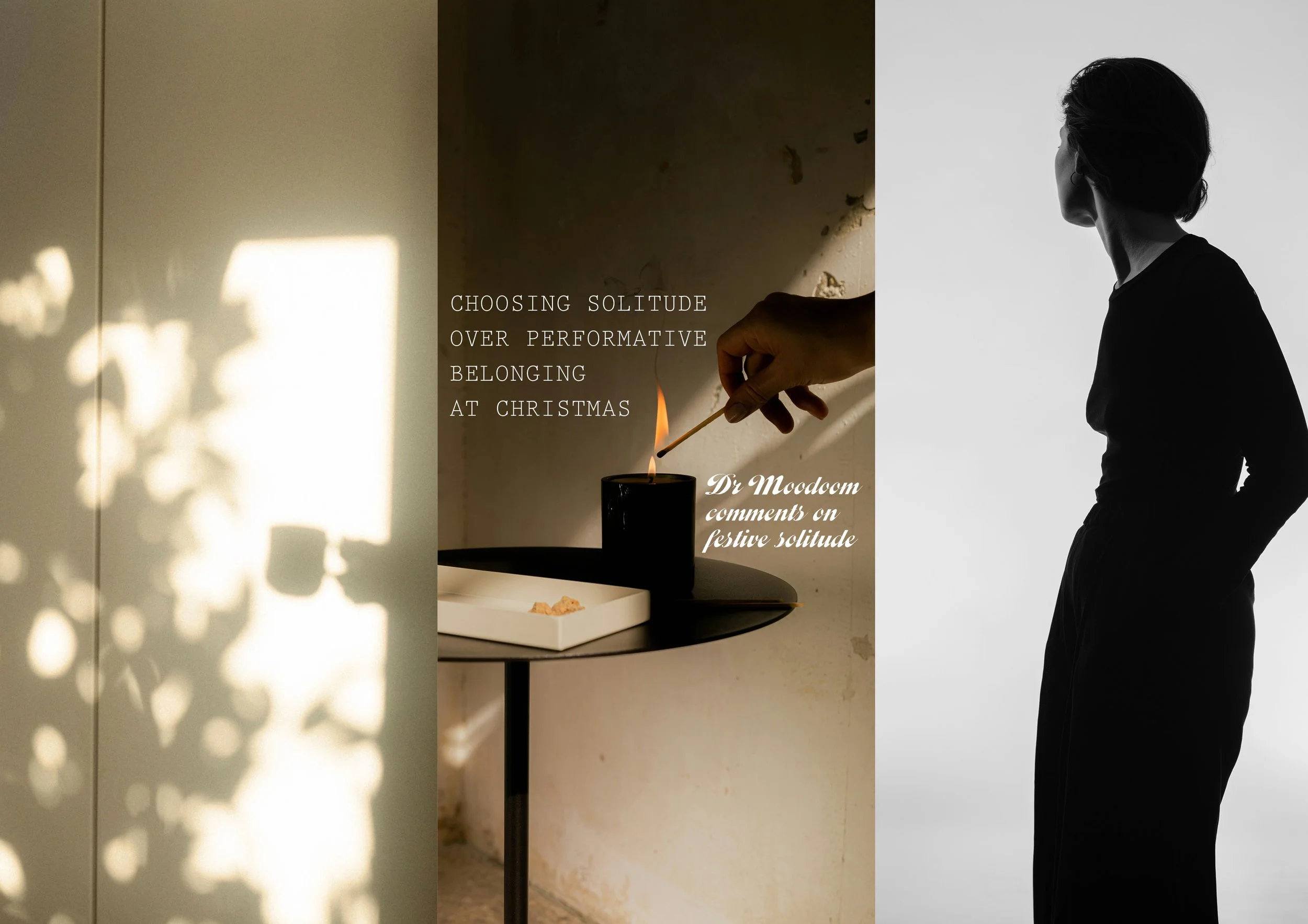
Choosing Solitude Over Performative Belonging at Christmas
I'm not talking about rejecting generosity or romanticising loneliness. It's about being discerning—which might mean saying no to an offer to conform at the Christmas table attended by people who aren't related to you, but for some reason want to make sure you don't feel excluded. This year's invitation came from someone I don't know well, who felt it her mission to ensure I celebrated Christmas "with us and our friends." My gut instinct screamed to decline. This new/old "friend" with a surplus of her own, and enough of everything to share with inadequate, unpartnered me. The invitation arrived framed as kindness but functioned to make the host feel decent, generous, inclusive. So I went to the movies instead.
I’m not talking about rejecting generosity or romanticising loneliness. It is all about being discerning, which might mean saying no to an offer to conform at the Christmas table attended by people who are not related to you, but for some reason want to make sure you don’t feel excluded. After all, it’s the festive season and that’s about offering kindness to “others”, including single you.
I have often found myself single at times of cultural high stakes, including Christmas and pretty much all of the festive season, until January returns again. I have accepted genuine offers to come to family gatherings I would have no business being at on any other day. Luckily I’m not homeless and I can afford food, but sometimes it does feel right to be among others, rip open a bonbon with a stranger and eat too much pavlova.
This year felt very different as I was invited by a person who I don’t know too well, who felt it her mission to ensure I celebrated Christmas “with us and our friends”. If she had said “lets celebrate Christmas together”, I might have just done so. But I already had my suspicions about this person, who had made contact many years after we went to high school together. We weren’t friends then either, but 2025 seemed to be for her to all about rekindling a friendship that was not there in the first place. My gut instinct screamed to decline, in the form of nausea and panic. I felt there was an agenda, which did reveal itself in various ways. There seemed to be a power imbalance, with her seeking me out, buying me gifts that made me feel uncomfortable, leading conversations with a presumed superiority, and now this invitation. An opportunity to ensure I didn't feel “lonely and left out”.This new/old “friend” with a surplus of her own, and enough of everything to share with inadequate and unpartnered me.
By offering me the chance to spend a celebration with her friends merely reinforced the popular idea that being alone at Christmas was something that could be prevented and avoided, if only I’d play along. Pick any random family, and pull up an odd chair. The family didn’t matter, being with people the only goal.
I could see myself being the odd one out and my new/old friend’s gathering, creating the need for a generous amount of small talk for everyone including me. I knew from past experiences that this type of Christmas invitation is less about welcome and inclusivity, and more about control and sanctimony. It arrives framed as kindness but ultimately functions to make the host feel and be seen to be decent, generous, inclusive.
I’d guess that by declining and being discerning I have come across as ungrateful and fragile.
The difference is subtle but unmistakable. Genuine offers feel lateral. You are spoken to as an equal, not absorbed as a project that “no single person is left to fend for themselves”. You blend in rather than stand out, the one making it an odd number around the makeshift christmas table. Making the trifle having to stretch over an odd number of dessert bowls. Meaning one person had to use a fork instead of a spoon for the fruit salad.
And don’t even ask how to tackle the bon bon popping with one person having to do it twice.
Christmas is uniquely efficient at exposing entitlement. It is a ritualised display of family, coupling, abundance, and belonging. Those who do not conform to the preferred configuration like myself, an unattached woman identified as a “guest” rather than an equal, welcome but to remain on the periphery. Not seated next to somebody else’s husband for fear of the rupture of a firmly held longstanding relationship, happy or not. A need to remain small and not very interesting for fear of upending connections that are unfamiliar to me.
There is also a quieter irony at work. Some of the people extending these invitations are themselves enduring Christmas rather than enjoying it. They are managing family obligations, performing harmony, tolerating dynamics they would never choose voluntarily. The table is full, but not necessarily intimate. Togetherness, in this context, is compulsory rather than desired. What better way to experience genuine loneliness, surrounded by “loved ones”.
Which makes the moral framing stranger still. The solitary woman is cast as the problem to be solved, while those privately counting the hours until the day ends are positioned as secure and superior. Loneliness is projected outward, as though presence is enough proof of belonging.
Anyway, this Christmas I remained authentic to my solitary predicament and went to the movies. This was not an act of withdrawal. It was a refusal to participate in a false situation that may have helped in the immediacy of Christmas day, but would have left me then obligated to be grateful to my new/old friends who, after all “made sure I was included at Christmas”.
I would rather not be single. But until that changes, I am not willing to live as though my life is on hold, killing time while the world turns for those playing along. Making the most of it is not denial, it is being genuine. It is choosing fullness where it is available, and refusing invitations, social or romantic, that ask me to shrink in order to belong.
Ironically, the film I watched was The Housemaid. A story about what happens behind closed doors in the most horrific of ways. The plot twisted and turned, I reeled and got caught up in genuine emotion and feeling, not forced smiling and listening to conversations about all the things that happened to a group of people on all the other times that I wasn’t there.
I left the cinema thinking about how much violence, hierarchy, and silence have always been protected by the idea of family, by walls mistaken for safety, by togetherness needing respect at all costs. I walked back into the evening alone. And clear. The day passes. The ritual ends. No harm is done.
As for my friend who I hardly know? I haven’t heard from her, thankfully, checking up to see if I have survived the presumed impossible. To see if she can help make me feel more like her and her friends. To continue scoring more points to keep me indebted to her
I am more resolute about 2026. I have started making plans to travel at times of tradition, including Easter, while the world continues to perform around celebrations, being pro-active, and living my best life as a single person.
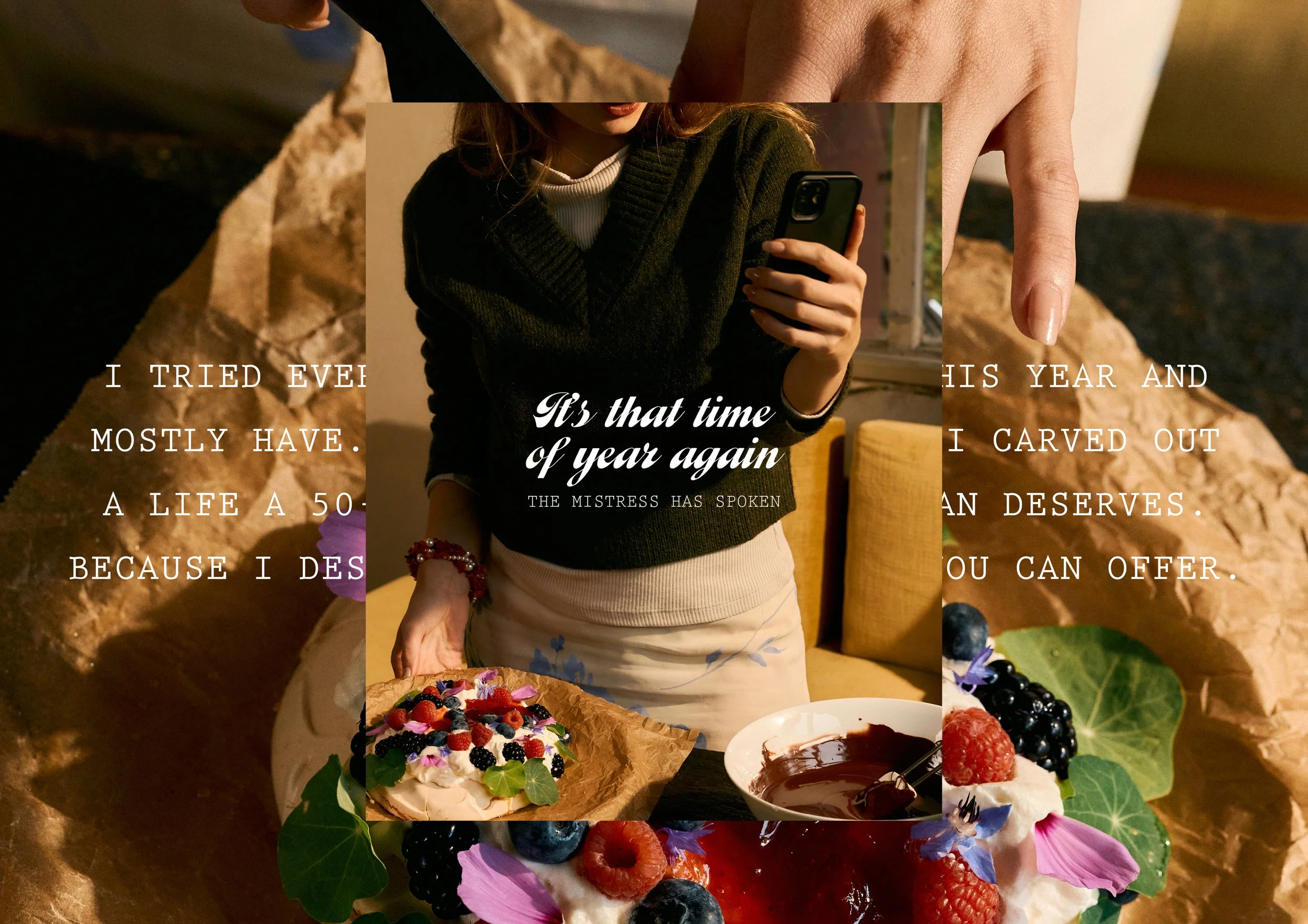
It’s that time of year again
I know it's almost Christmas because you've stopped communicating with me, just like every other year. We've gone from banter about our days, sliding into smut, flirting, joking, then back to reflecting on our day to absolutely nothing. I'm guessing it's all the distraction with needing to keep up the family man role, driving around town with your family inside the car oblivious to your other relationship. The almost five-year relationship with me. I don't talk to my friends about this—they're all married and would be insecure. So I talk to ChatGPT, who gently implies I need to get my shit together. The Mistress on annual Christmas silence, rushed sex, and finally understanding what she deserves.
When the family man goes silent for Christmas, the mistress gets clarity
By The Mistress
I know it’s almost Christmas because you’ve stopped communicating with me, just like every other year. We’ve gone from banter about our days, sliding into smut, flirting, joking then back to reflecting on our day to absolutely nothing.
I’m guessing it’s all the distraction with needing to keep up the family man role, driving around town visiting all the people who don’t really have a clue about who you are, with your family inside the car oblivious to your other relationship. The almost five year relationship with me.
I don’t even bother trying to talk to my friends about you or this predicament. They are all married and would be very insecure talking about this, and I don’t want to make people I love uncomfortable. I don’t even want to make you uncomfortable, challenging you on this predictable behaviour. I simply put up with the silence like it’s part of the deal. A deal I don’t understand or determine. A deal I talk about with ChatGPT, who gently but reassuringly continues to imply I need to get my shit together.
A year ago to the day I received your message out of the blue that your wife was onto you and you needed to pull back. I didn’t reply because I didn’t know if it would be safe to do so, and also what was the point? I tried to distract myself over Christmas by spending time with friends but I also let myself grieve and mourn. We have seen each other once since then for 20 minutes. Rushed sex in a random moment. We have had many more conversations since that encounter a few months ago, after months of literally nothing.
I wonder, has she noticed something again?
Anyway, I do admire that I tried everything to get over you this year and mostly have. I dated, had disasters, some I told you about, some I didn’t. I tried to continue carving out a life that a 50 something successful woman deserves because I know I deserve way more than what you can offer. I no longer think we will ever be together. If we were ever caught, you’d still beg to stay in your marriage. You know exactly how hard it is to be single, you’ve heard it from friends and there’s no way you’d do it with your super compounding and property portfolio expanding.
And if you think I’m bitter, I’m really not. I’m tired and I’m disappointed in myself. But I’m also proud because I continue to question, what else is there for me? I don’t want to be alone and I really miss sex. I don’t want to be a lover that is always discarded in a relationship that only works because I have no say or no power.
I’ll thank the universe for these moments of quiet, absent from the distraction of you as I create,carve out and call in the next stage of my life, knowing you probably won’t be a part of it.
Unless you say hello again around the 3rd of January…
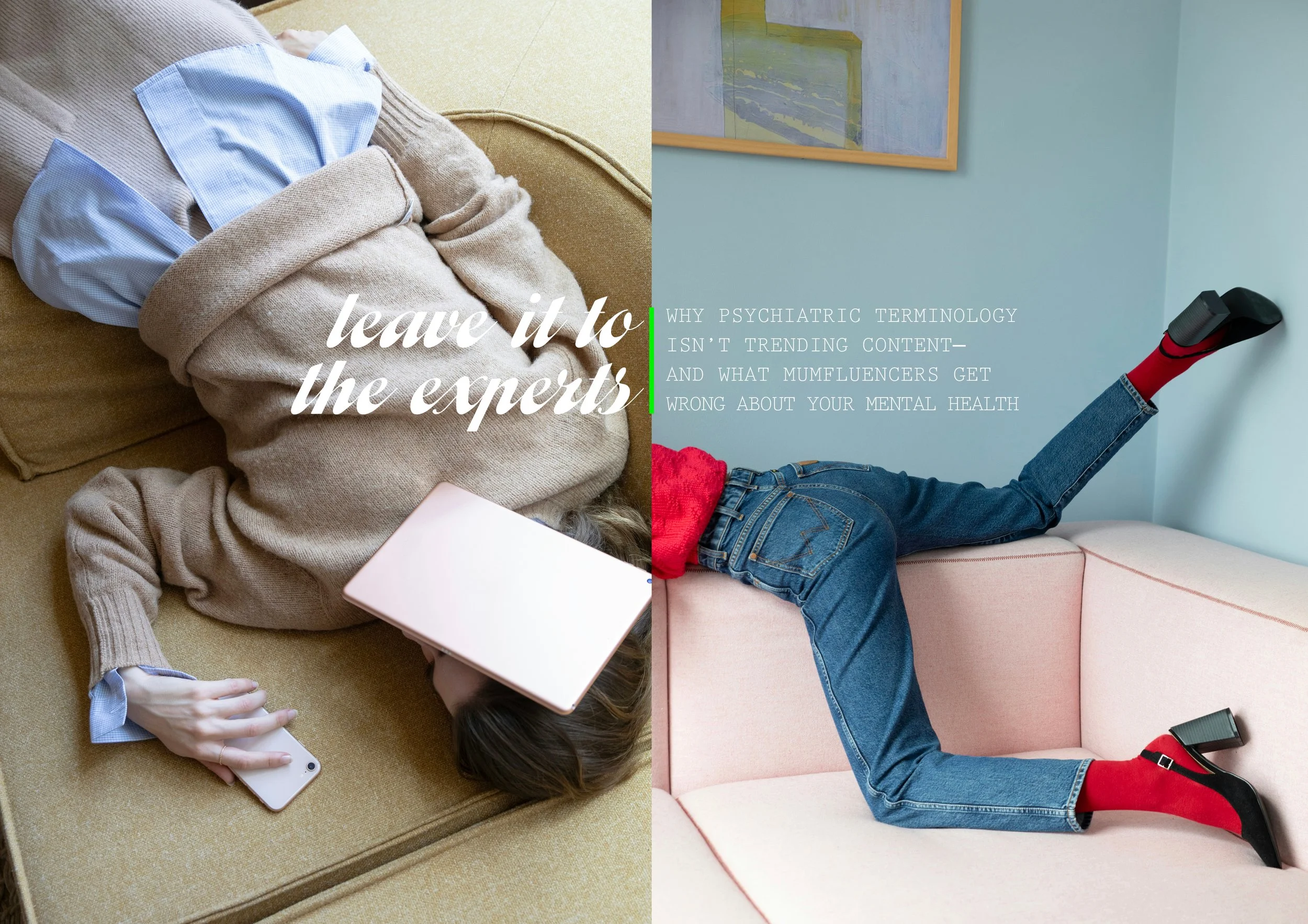
Leave it to the experts
Contrary to popular belief, you need qualifications and a lot of smarts to be a psychiatrist. The human mind is way more complicated than a 20-second TikTok reel. Our insurance costs a fortune because unlike wellness practitioners, life coaches, and every second mumfluencer, we can actually be held accountable for advice that harms people. Psychiatrists don't give advice on social media—what we give is called treatment, tailored to the individual, not designed to win sponsorships. You can't be "triggered" by a cancelled Uber. Missing the train isn't trauma. There's no such word as "boundaried." Dr Moodoom reclaims psychiatric terminology from the content creators.
Why psychiatric terminology isn't trending content—and what mumfluencers get wrong about your mental health
By Dr Moodoom
Contrary to popular belief, you do need a few qualifications and a lot of smarts to be a psychiatrist. The human mind is way more complicated than what can be demonstrated on a 20 second TikTok reel.
Our insurance costs a lot, but they are essential because, unlike wellness practitioners, life coaches and every second mumfluencer, we can actually be held accountable for advice that harms people.
The best way to tell a psychiatrist from a non psychiatrist is that psychiatrists don't give out advice on social media. That's because the advice we give is actually called treatment and as such is tailored to the individual, not to win sponsorships or free shit. And we use very different terms for things because, well, we are medically trained and not hashtag fuelled. For example, in my entire training did I never go to a lecture about triggering, noun verb or otherwise. We occasionally referred to the 1-2% of the population who had PTSD as identifying triggers for being reminded of traumatic events. That’s real trauma involving death or near death experiences, not missing the train and being rained on, or missing out on a promotion at work. They are called setbacks or disappointments, and rarely play on the mind after they are over.
You can’t be “triggered” if somebody doesn’t agree with you, or if somebody does or says something that reminds you of an ex from a dating app. That’s called getting sad or upset which is perfectly normal, and not to be posted about. And the same for the overuse of the word “boundaries”. The term boundary is used to describe a delineation between two states or locations, and not amorphous constructs and how we enjoy or dislike being treated. There is no such word as “boundaried” and mums teaching their kids on Instagram to have good ones is a 2025 version of telling them to treat others the way they want to be treated.
Psychiatrists have a lot to say about the overuse of terms such as “emotional regulation” too. A dysregulated emotional state is not the one expressed when you can’t find a car park or your Uber gets cancelled. Kids can get “dysregulated”, but again, only briefly and it’s more appropriate to call that a temper tantrum. So if you are reading this and not three years old, then choose another term for what you’re experiencing, even if that hashtag isn’t trending. More need said about how to spot a narcissist than what is actually being said, so I’ll get that sorted for you as well.
So the next time you take advice from a “content creator” on social media be mindful that what they are espousing is curated nonsense for an algorithm. It has nothing to do with any understanding of human afflictions or emotions and everything to do with making you look stupid for adopting their jargon.
Choose your own adventure at work
Once upon a time, people met their partners at work. Connections developed organically across boardrooms and operating theatres. Nowadays, such behaviours generate a meeting invitation with HR. We're living in an age where sexual harassment training has replaced sexual chemistry, and every workplace romance is a potential PR disaster. Yet in the same breath, we're told to ask colleagues we can't hit on, "RUOK?" It's as if we must never acknowledge attraction but must always acknowledge distress. After two conflicting offsites, attendees learn that asking somebody out is 2025 taboo, but asking about their mental health is 2025 encouraged.
When flirting becomes outlawed in the workplace but genuinely checking in is mandatory, the only winners are the heroes in HR.
Once upon a time, people met their partners at work. Doctors found nurse wives at the hospital and bosses enjoyed downtime with their secretaries. Yes, some of this behaviour was predatory but most of it wasn’t. When things made sense, connections developed organically and casual stares across a boardroom or operating theatre provided the foundations for what was often a marriage or long-term relationship.
Nowadays, in the wake of everything that feels like fun must be bad (and potentially vulnerable to legal or disciplinary action), such behaviours generate a meeting invitation with HR and a note that support people are welcome to attend.
We’re living in an age where sexual harassment training has replaced sexual chemistry, and every workplace romance is viewed as a potential PR disaster.
And yet, in the same breath, we're told to ask work colleagues that we can’t hit on, "RUOK?" Then, if we’re really lucky, we might get chosen to attend an offsite to complete mental health first aid training.
It’s pushed down our throats to ask colleagues “is everything good at home behind your closed door”, without following up with a compliment about a new hairstyle. It’s as if we must never acknowledge attraction—a dangerous slippery slope—but we must always acknowledge distress as an act of compassion. We must be respectful of others’ needs for personal space without letting anybody feel isolated and alone at their hot desk.
Attending training about sexual harassment in the workplace is a pretty dismal experience. Everybody appears to be interested but nobody is enlightened. The term “power imbalance” is thrown around quite a lot, as if it's a new phenomenon. Role plays make for very uncomfortable viewing. Nobody learns a thing, and everybody hopes anything they say or do falls over the right side of the line.
Then, three weeks later, comes R U OK? Day, when the same facilitator urges the team to have “meaningful conversations” that facilitate the same people from the role plays to open up and confide in the same people who just learnt the importance of respecting somebody’s personal space.
After two seemingly conflicting offsites, attendees learn that asking somebody out at work is 2025 taboo, but asking someone about their mental health is 2025 encouraged.
Consider this role play script:
“Hey, you seem quiet. Are you okay?”
“I'm fine.”
“Are you sure?”
“Yes.”
“Okay, just checking. You know I care.”
At mental health first aid training, this conveys empathy. Role play this at the sexual harassment offsite and we're talking written warning.
Maybe training and venue costs could be minimised if HR got savvy and combined the two PD activities, smashing the whole lot out and clarifying any unintended confusion.
Something along the lines of “how to be human in the workplace and adopt common sense”.
Modules could include:
How to Compliment Without Career Consequences
Asking R U OK? Without Sounding Like You’re Trying To Pick Up
Recognising the Subtle Difference Between Support and Stalking
Not that common sense is ever regarded at management or HR level, but it's worth a try.
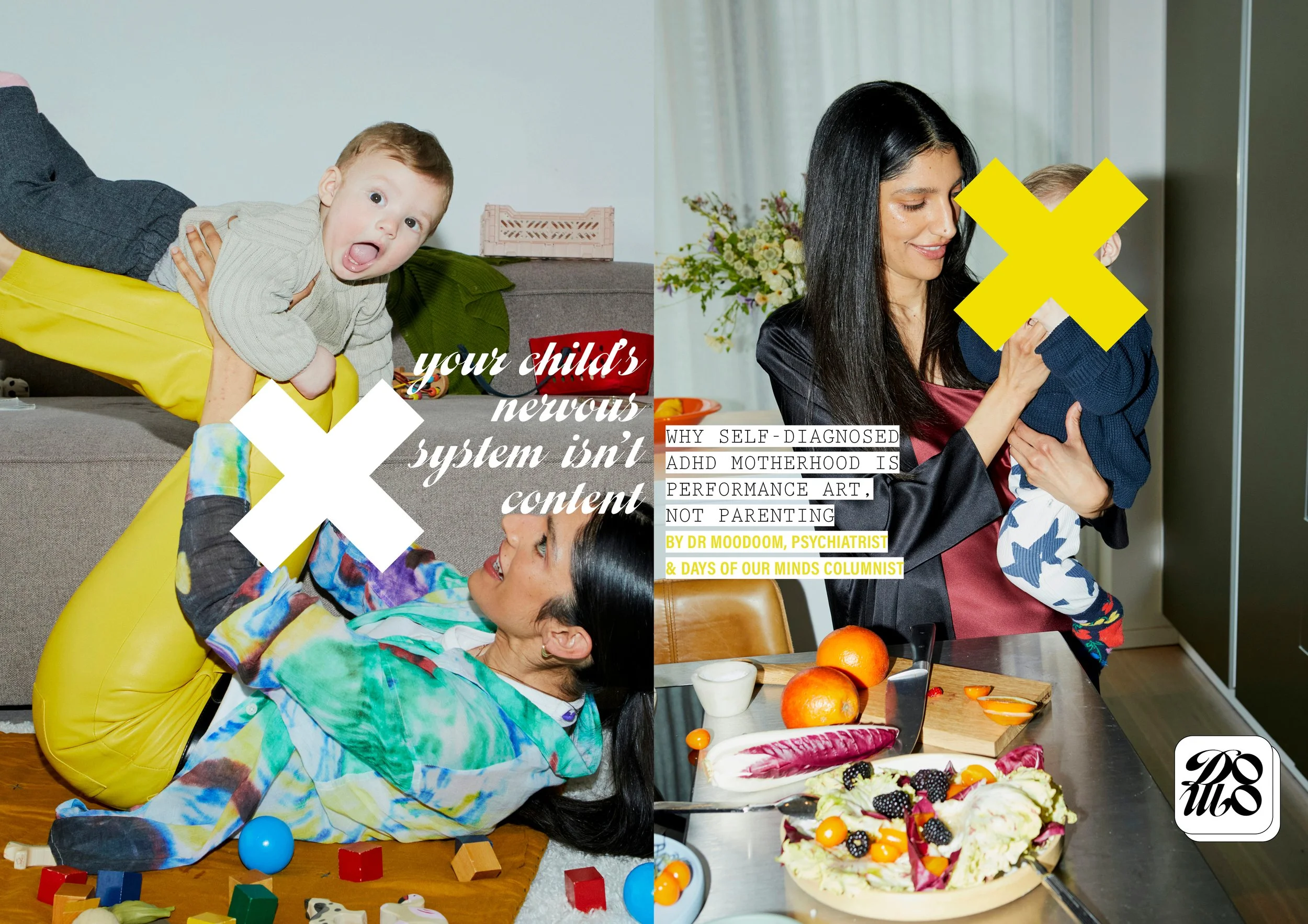
Your Child's Nervous System Isn't Content
The video opens to reveal a mother in her kitchen, one arm outstretched holding the selfie stick, her child mid-tantrum. The child screams—not from dysregulation but from an intuitive awareness that they've been enrolled in their mother's content strategy over an actual playdate. She's hoping to beat her record for views and new followers. She expects new Lululemon merch for this one. Welcome to self-diagnosed ADHD motherhood, where parenting isn't about guiding a child through the world but narrating one's own influencer journey through the child. Dr Moodoom dissects the four-step process—and asks what happens to children trained in content strategy instead of emotional regulation.
Why Self-Diagnosed ADHD Motherhood Is Performance Art, Not Parenting
By Dr Moodoom, Psychiatrist & Days Of Our Minds Columnist
The video opens to reveal a mother in her kitchen, one arm outstretched holding the selfie stick, the rest of her body turned to “see” her child mid-tantrum. The child screams—not, one suspects, from dysregulation but from an intuitive awareness that they’ve been enrolled in their mother’s content strategy over an actual playdate. And she won’t stop until she gets the perfect reel.
No need for sound. She’s added captions:
“The most important thing an available mother can do is be there to regulate their children’s dysregulated overstimulated brains”
She’s hoping to beat her previous record for views and new followers. She’s applied the Meta-on trend soundtrack and submitted it for the world to see. She expects new Lululemon merch and face masks for this one. Perhaps a weekend away as well.
Welcome to the age of self-diagnosed ADHD motherhood, where parenting isn’t about guiding a child through the world but narrating one’s own influencer journey through the child.
Step One: The Self-Diagnosis
It starts innocuously enough. A late-night scroll leads to a quiz: “10 Signs You Might Have ADHD.” She ticks most boxes—who wouldn’t? Difficulty focusing during boring tasks, forgetting where you put your keys, struggling with time management when you’ve overcommitted to everything.
Suddenly, her entire identity reorganises around this revelation. Every forgotten birthday card, every impulse purchase, every half-finished project now has a medical explanation. She’s not disorganised—she’s neurodivergent.
The relief is immediate and intoxicating. Years of feeling “not quite right” finally have a name. Never mind that she’s never been clinically assessed, that her struggles might stem from chronic sleep deprivation, unrealistic expectations, or simply being human in an overwhelming world.
The diagnosis is complete before a single professional has been consulted. And why would she need one? The internet has spoken. The other mumfluencers have validated her. She’s found her tribe.
Step Two: Convert the Children
Naturally, she begins noticing the same traits in her offspring. She knows that reactions to food dyes and eating non-organic food that actually contains carbon gets her nowhere on the algorithms.
Little Finn’s meltdown? Emotional dysregulation. Ava’s dislike of homework? Executive dysfunction. The family cat’s 3 a.m. zoomies? Probably dopamine-seeking behaviour.
Of course her children still look stunning and polished in their bespoke clothes—just the right amount of chaos and imperfection so she still rates as an incredible mum, vulnerable and all. Looking youthful and mature simultaneously.
She gleefully applies #ourneurospicyhousehold to everything.
Step Three: Therapeutic Parenting™ [A Masterclass in Performance]
Once upon a time, a parent might have said “No.” Now, the ADHD mother says:
“I see you’re having a big feeling right now. Mummy is going to be present with your nervous system while you throw things.”
She crouches down, breathing audibly through her nose like a mindfulness app on human legs, while her child kicks and screams and throws Barbies at the wall. The phone, still filming, captures every moment of the healing journey. Hopefully the performance won’t need a morning full of takes, and the editing will be done in a jiffy. The distraction that actually led to the child choosing new behaviour—the shiny iPad—is not in shot.
Step Four: Traversing the Child’s Development for ‘Gram Content
Eventually, the child, now seven, refuses to be filmed mid-meltdown. This is reframed as “autonomy.” A new post goes up:
“We’re entering a season of consent and boundary-setting 🌙. I’m so proud of his regulation journey—even when he tells me to stop posting him. I just remind him of how much free shit he gets too, and he gives me what I want.”
What’s Actually Happening Here
As a psychiatrist, I watch this phenomenon with clinical fascination and genuine concern. These mothers aren’t necessarily bad parents. What they often crave isn’t validation of a diagnosis but relief from the chronic self-blame of modern motherhood. ADHD becomes shorthand for “I’m not lazy, I’m overloaded.”
I understand that appeal. In a world that demands perfect parenting, perfect bodies, perfect homes, and perfect content—all simultaneously—a diagnostic label offers absolution. It’s easier to say “I have ADHD” than “I’m drowning in unrealistic expectations.”
The problem emerges when that narrative expands to include the child. When family life becomes therapeutic performance art. When nobody actually gets regulated, least of all the one behind the camera.
What’s really happening? The child is being trained not in emotional regulation but in content strategy. They’re learning that feelings are currency, that vulnerability is performative, and that love comes with a ring light attached.
The Choose Your Own Adventure Model
It really is a “choose your own adventure” scenario for these mumfluencers. Either be the “I do not care” one displaying all the chaos and asking for acceptance or support, or be the perfectly toned, stunning, youthful “my child and I share our diagnosis and wear it as a badge of honour” mum.
Either way, whatever works for you and your bank account.
But let’s be clear about what we’re actually diagnosing here. ADHD is a legitimate neurodevelopmental disorder. It’s not a personality trait acquired through Instagram polls. It’s not an aesthetic. And it’s certainly not a brand.
Real ADHD requires comprehensive clinical assessment—not a quiz that arrives with your morning sponsored skincare routine. It involves standardised rating scales, developmental history, functional impairment across multiple settings, and ideally, input from multiple sources.
What these influencers are doing is taking complex psychiatric presentations and flattening them into content. They’re medicalising normal human struggle, then monetising it.
The Actual Cost
The children in these scenarios will grow up fluent in therapeutic language but potentially illiterate in genuine emotion. They’ll know how to perform regulation but may struggle with actually experiencing it. They’ll understand that feelings generate engagement but might never learn that feelings also deserve privacy, processing, and protection.
And when these children eventually seek actual psychiatric help—because being raised as content often creates its own trauma—they’ll arrive with a vocabulary that sounds clinical but a presentation that’s anything but.
They’ll describe their childhood in hashtags. They’ll reference their mother’s posts as if they were medical records. They’ll struggle to separate their actual experience from the curated version that lives online.
A Modest Proposal
So here’s my professional recommendation, delivered without a ring light or a sponsored hoodie—if you think you have ADHD, see a psychiatrist. Get a proper assessment. If your child is struggling, seek professional help from someone whose primary motivation isn’t follower count.
And if you must post about parenting—and apparently we all must—consider this radical notion … some moments aren’t content. Some struggles aren’t for sharing. Some aspects of your child’s development deserve to remain private, unfilmed, and unmemorable to anyone except the people who were actually there.
Your child’s nervous system isn’t a growth strategy. Their dysregulation isn’t your engagement metric. And their consent shouldn’t come with a reminder about free merchandise.
The internet rewards self-disclosure wrapped in diagnostic labels. But your child deserves better than to be the supporting character in someone else’s mental health journey.
So before you hit record on that next meltdown, ask yourself—am I documenting this to help, to process, to connect? Or am I performing parenthood for an audience that will scroll past in three seconds?
Because one of those serves your child. The other just serves the algorithm.
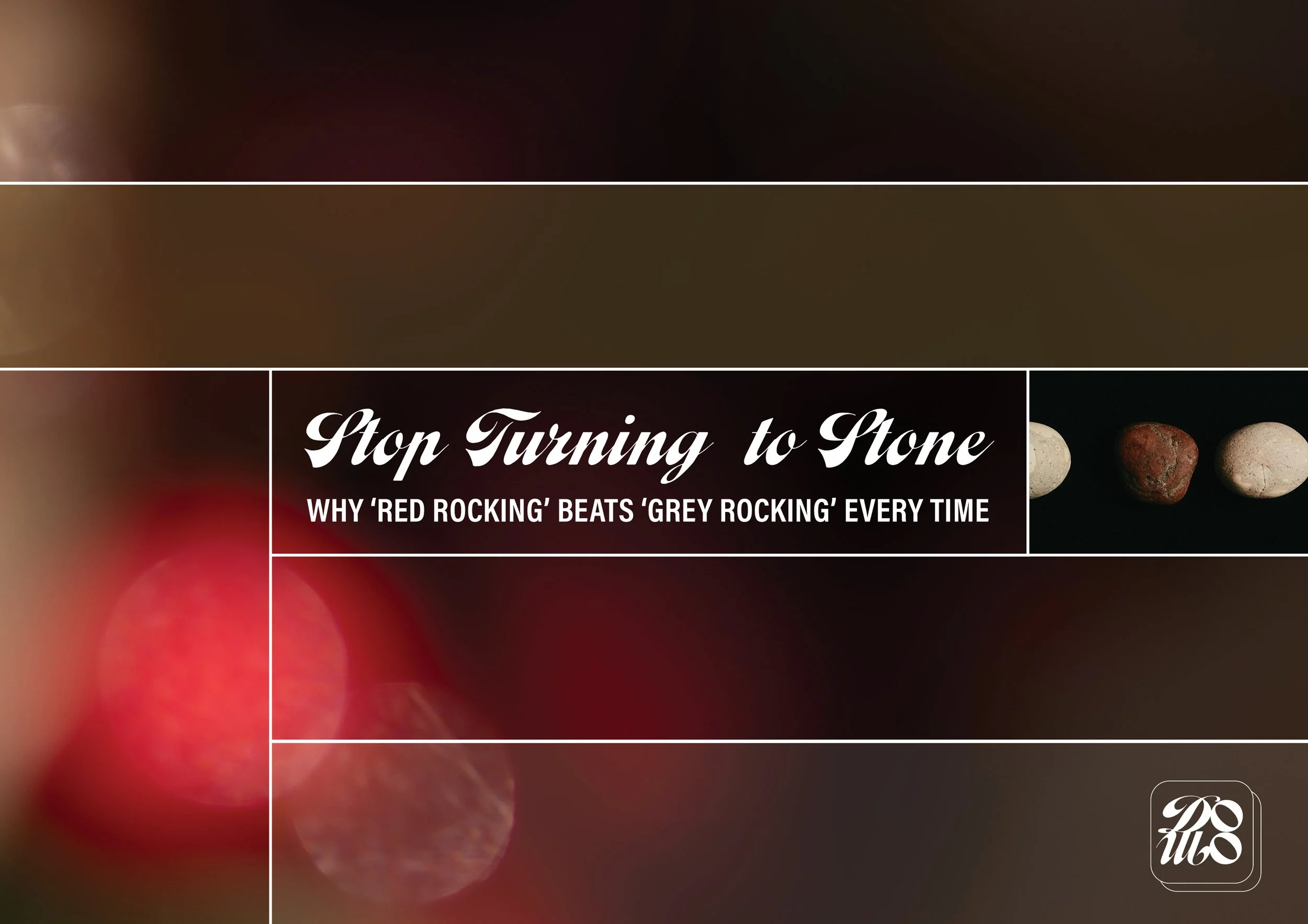
Stop Turning to Stone
"Grey rocking" may feel like emotional self-protection, but psychiatrist Dr. Moodoom argues it’s actually emotional hibernation disguised as strength. Instead of numbing yourself to survive manipulation, he proposes “Red Rocking” — a strategy rooted in calm assertiveness, self-expression, and reclaiming your emotional colour. It’s not about matching toxicity, but about staying vividly, powerfully yourself.
Why ‘Red Rocking’ Beats ‘Grey Rocking’ Every Time
By Dr Moodoom, Psychiatrist & Columnist
The latest term to hit the internet avoiding scientific rigour or psychiatric usefulness is that of “grey rocking” — a survival strategy where you become as uninteresting as possible to a narcissist. That is, a loosely diagnosed narcissist who wouldn’t ordinarily find themselves formally diagnosed because they simply don’t find the need to present for professional help.
The main mantra espoused by millennial influencers everywhere is to adopt the stance of:
“Don’t react, don’t feel, don’t engage. Be neutral. Be dull. Be as boring as a grey rock”.
On the surface it looks like the perfect coping strategy for our times: minimal effort, maximum illusion of control. But let’s be honest — the “grey rock” isn’t enlightenment. It’s emotional hibernation dressed as empowerment. And psychiatrically speaking, it’s a terrible long-term strategy.
I understand the appeal. It promises safety without confrontation. In a world apparently overrun by “narcissists” (half of whom we met on dating apps, the other half at work), grey rocking offers an enticing exit from chaos. The problem is however that it also strips you of your vitality — your capacity to express, to assert, to connect.
And ultimately gives the “narcissist” more control of you as they make you change your behaviour, just in an entirely different way from reactivity and emotion.
As a psychiatrist, I watch people self-diagnose entire social circles with personality disorders, then congratulate themselves for being able to rise above it without diagnosing themselves. Everyone’s busy avoiding each other in the name of mental health. We’ve become a civilisation existing in all forms of isolation, on every conceivable level.
My extensive experience and insights derived from actually talking to patients and diagnosing them if relevant has led me to create to my offer of trite labelling. It’s a “if you can’t beat them join them strategy that may not entice the algorithm, but definitely offers a better way to exist.
I offer an alternative: Red Rocking.
Where grey rocking says, “I’ll survive by disappearing,”
Red Rocking says, “I’ll survive by staying myself.”
It’s not about shouting or matching toxicity — it’s about clean assertiveness. Controlled heat. It’s saying, “I see your manipulation, and here’s my boundary, stated calmly, enforced consistently.”
It allows you to rage if you need to, whether or not you perceive this gives the narcissist oxygen. Who cares because you need a place to put your heated emotions too.
Here’s what that looks like in practice:
Notice the trigger. Know exactly what behaviour violates your peace.
Name it internally. “This is disrespect.” “This is blame-shifting.” Naming grounds you.
Speak briefly, clearly, and once. “Don’t talk to me like that.” “This topic is off-limits.”
Reclaim colour. After the encounter, do something vivid — music, laughter, light. Reaffirm that you are not grey.
This may sound like more pop psychology but it isn’t. It’s a sophisticated approach that doesn’t describe emotions as pantone colours or inert dead objects.
Red Rocking is what happens when emotions get expressed exactly as they should. Because dealing with a true narcissist, one that is actually formally diagnosed and exhibits characteristics that are harmful, calculated and repeated, requires way more than a one size fits all approach.
Because you can’t coexist on a planet full of loosely diagnosed narcissists by numbing yourself. You coexist by defining yourself, being angry, hurt and damaged by wounds, getting back to safety and recovering.
So next time someone tells you to “just grey rock your ex,” smile politely, stay calm, and think; actually I’ll do what serves me right now given the injury I’ve just sustained.
"Where is your husband?" and other questions that ruin your poolside peace
I've recently returned from another solo holiday, because I need holidays like my coupled friends and I'm not waiting around until I stumble across or swipe on a partner. At reception, making polite small talk after correcting the "Mrs" assumption, I was asked: "Where is your husband?" Paralysed by what the best answer would be, wanting to minimise disappointment—both to the person who asked and to myself—I heard myself say: "I don't know." Which, technically, is true. But this response may have left way more questions than intended. Did I have a memory problem? Had we argued? Had he been murdered and they hadn't found the body yet?
Travelling solo in a world that still assumes everyone needs a twin share
I’ve recently returned from another solo holiday, because I need to have holidays like my coupled friends and I’m not waiting around until I stumble across or swipe on a partner.
I ventured down to reception for some matter when I was drawn into polite small talk after correcting the “Mrs” assumption. The small talk drifted into a seemingly innocuous question that revealed way too much and led to an afternoon of overthinking.
“Where is your husband?”
At that moment, I didn’t know exactly what to say, paralysed by what indeed the best answer would be, and wanting to minimise the disappointment, both to the person who asked me and to myself.
I heard myself say,
“I don’t know.”
Which, technically, is true.
Because, philosophically, I haven’t met him yet. And practically, I barely speak to my ex-husband, and wouldn’t have a clue where he was.
Later with overthinking applied I realised that this response may have left way more questions than the question intended.
Did I come across as having a memory problem?
Did it look like we had argued and he’d left?
Did it look like he had been murdered and they hadn’t found the body yet?
In an attempt to fit in with the norm, I became the outlier. The weird guest nobody could work out. The person who takes two deck chairs and sits on one. Who orders two cocktails at happy hour and double parks them. Who takes their book to dinner rather than someone to take photos of them.
What should I have said?
Of course I should have said,
“I don’t have one of those, I’m single”.
However, I know if I had done that, my afternoon by the pool would have been spent spiralling, recognising his facial expression as conveying a mixture of pity and concern about what was indeed wrong with me, and trying to positive self-talk my way out of my response.
Focusing on my book, ignoring all the couples in the pool and trying to appreciate the solitude.
Failing desperately until happy hour rolled around again, or it would be dark enough to head to bed.
Because here’s the thing — the world is still built for pairs. Two towels. Two glasses. Two keycards. Even the hotel slippers arrive in twos, just to remind you that you’re the odd one out.
You can be competent, solvent, and serenely self-contained, but there’s still that quiet societal glitch — as if a woman alone must be the result of a malfunction.
I’d like to put a spin on it, but I’ll leave that for others who take to social media when travelling solo, posting photos every 10 minutes and waiting for likes and comments because they are craving connection too.
Just like this solo traveller.

Are you a friend or a finger?
You pride yourself on sending carefully considered messages to others. You choose your words with care—not too heavy, not too light. You want to express something meaningful, something real, something unambiguous. And then you get the reply: 👍. That single, tidy emoji—efficient, polite, and utterly deflating. You sit there, re-reading your message, wondering why you bothered to write at all. The thumbs-up says everything and nothing all at once. It's a full stop where there could have been a comma—a closing door where an open one might have let something more human in.
The quiet ache of one-sided effort
You pride yourself on sending carefully considered and unhurried messages to others, now that phone calls are hardly the done thing and it’s the best that modern day conversation can offer. You choose your words with care — not too heavy, not too light. You want to express something meaningful, something real, something unambiguous.
And then you get the reply: 👍
That single, tidy emoji — efficient, polite, and utterly deflating.
You sit there, re-reading your message, wondering why you bothered to write at all. Did they even read it? Did it land anywhere close to where you hoped? Or was the response just one more task in an overloaded multitasking list? The thumbs-up is one of the great inventions of digital minimalism. There’s a reason it’s used more than many emojis. It says everything and nothing all at once. It’s a full stop where there could have been a comma — a closing door where an open one might have let something more human in.
It’s not cruelty. Most of the time, it’s not even neglect. It’s just how communication has changed. People are tired, overstimulated, scrolling through dozens of threads a day, replying in shorthand to manage the overwhelm.
But when you’re the one who still writes with intention — who believes that words are an act of care — it can sting. It can feel like you’ve spoken into a canyon and received only the echo of your own voice back. It can make you feel even more concerned about the quality and quality of your friendship.
The truth is, thoughtful communication will always feel a little risky. It requires vulnerability. It’s easier to react than to respond, easier to acknowledge than to engage. But when we default to the emoji instead of the effort, we lose something precious — the small, sustaining act of human connection.
So maybe this is an invitation — to pause before sending that thumb. To type a few words instead:
“I read this — and I hear you.”
“Thank you for sharing that.”
“Let me think about it and come back to you.”
Because behind every carefully written message is a person who hoped you’d meet them halfway.
And sometimes, that’s all any of us really need.

Mansplaining at its best – how to use a chopping board
There's a special kind of awkwardness that happens when a man, trying to impress you on a date, decides to explain something you already know. Not in a friendly, conversational way—but in a slow, deliberate tone, as if you're a toddler learning the difference between a fork and a spoon. Third date, good chemistry, flowing conversation. Then he leans in to explain that colour-coded chopping boards exist to prevent contamination. Followed by a lecture on shoe racks. Yet another person who shows potential before mansplaining blows it all up.
Maybe we have missed the point, and you just speak out loud all of your internal dialogue. When you see a random object or open an app on your phone you are actually just sharing your thoughts. Surely, you don’t actually think a woman needs the sort of primitive advice you like to dish out at every opportunity?
Mansplaining is when a man explains something to a woman in a condescending or patronizing way, assuming she knows less than she does. It’s not always intentional, but it’s always irritating. Especially when it happens over dinner, under candlelight, with someone who’s supposed to be on their best behaviour.
From a woman’s perspective, mansplaining is never required and always infuriating. We are exposed to it every day, but the worst place to encounter it is on a date, when you should be focusing on putting your best foot forward.
There’s a special kind of awkwardness that happens when a man, trying to impress you on a date, decides to explain something you already know. Not in a friendly, conversational way—but in a slow, deliberate tone, pitching information to the level of a toddler who is learning the difference between a fork and a spoon. And then doing it over and over again.
Let me paint the scene.
We’re at a cozy restaurant. It’s the third date and there’s definite chemistry. The wine is good, the conversation is flowing, and I’m thinking, maybe this guy has potential. I tell him about my new kitchen and how excited I am to be buying new appliances and gadgets. It’s great to be sharing a little bit of my life with another human. Then, out of nowhere, he leans in and says:
“You know those fancy chopping boards with the little tabs? They’re colour-coded for a reason. Red is for meat, green is for vegetables… they’re designed like that to stop you from contaminating your food”
He pauses, waiting for my mind to be blown.
Without noticing the non verbal communication that is then screaming at him, he has another try.
He gives me a talk about how to use the shoe racks in my new wardrobe.
I felt despondent and defeated. Yet another person who shows potential before everything blows up in my face.
Why Do Men Do This?
Is it a throwback to when men believed they ruled the world and made everything happen? Or that they simply can’t just listen and nod along, with silence being awkward?
Or do they default to thinking they are the smartest person in the room, except when the other people in the room are men?
One thing I do know for sure is that explaining basic things to someone who didn’t ask is not impressive—it’s annoying. And it’s especially annoying when you’re quick to complement the owner of the new chopping boards for being intelligent.
What to Do Instead
It’s actually not that hard, and the avoidance of mansplaining on dates can be extended to absolutely every other conversation had with a woman. To be completely transparent, here’s a few rules for life:
Ask questions.
Share stories.
Be curious.
Listen
Shut up.
Because nothing says “I’m into you” like treating someone as an equal.
Final Thought
So to all the well-meaning men out there: if you’re on a date and feel the urge to explain something—pause. Ask yourself: Did she ask? Does she look confused? Did she make a statement or ask a question? Is this a TED Talk or a dinner date?
And if the topic is chopping boards… maybe just say she looks lovely instead.

His mistress is your new best friend
Actually, I don't want to be your best friend either. But I've got your attention now, and you might want to listen. Because of my unique position in your marriage, I know exactly why your husband is in this secretive relationship with me - and it might not be what you think. While society loves to cast the "mistress" as a villain, what I know about how we all got here is the critical information you need. It's not just about sex. It's about scarcity, appreciation, and the basics you've both stopped giving each other.
What the other woman knows about your marriage—and no, she's not trying to break it, you've already done that [THE MISTRESS BREAKS DOWN WHAT SHE KNOWS]
Actually, I don’t want to be your best friend either. But I’ve now got your attention and it might be a good idea to listen to what I have to say. Because of my unique position in your marriage I know exactly why your husband is in this secretive and often precarious relationship with me. And it might not be because of what you think.
While society loves to cast the “mistress” as a villain, the sole cause for a marriage to end or in some cases become stronger and continue, is not me. But what I know about how we all got here in the first place is the critical information you need.
1. It’s Not Just About Sex
The physical intimacy I have with your husband is pretty next level. I’m not going to minimise that. It’s also hurried, sporadic and impulsive, when he can get away and when we won’t be discovered. It’s intense because of the time we spend talking, and we don’t just talk about what we will do sexually when we see each other. He feels very close to me because I give him a lot of time to talk and be seen. I remember what he was planning to do that day and I check in to see how he’s going. I even listen along to all the developments involving your children. I do it because I enjoy it too. We are close because we communicate and that is often lacking after years of raising kids and living parallel lives as parents.
2. Scarcity: The Mistress’s Secret Weapon
This idea comes from behavioural economics and psychology — when something feels limited, rare, or forbidden, it becomes more valuable. In affairs, secrecy and limited access can amplify desire, making the sexual element seem more intense than it might otherwise be. An unfair advantage I agree, when you see him every day and at his sloppy best and I don’t.
3. The Mistress as a Mirror (And Occasionally a Magnifying Glass)
I’m not just a threat to your marriage but I’m also a reflection. By listening to me you’ll find out exactly what’s missing according to my lover. As a teaser I’ll let you know it’s the basics. He doesn’t feel appreciated, and maybe you don’t either. It’s just that his solution for that isn’t the same as yours. You can whinge to your yoga mates until you’re exhausted and they will absolutely validate you because they feel the same way. He’ll just feel very appreciated by me
5. Affairs Are Relationships Too (Yes, Even the Illicit Ones)
Here’s the uncomfortable truth: affairs can evolve. They can deepen. They can even become real relationships.
With enough emotional input, communication, and mutual growth, what started as a secret rendezvous can morph into something more stable. It’s rare, messy, and often socially frowned upon, but it happens.
Affairs are like bonsai trees—small, hidden, and requiring obsessive care to survive. Most die in the dark. But some—with sunlight, pruning, and a complete moral overhaul—grow into something strangely beautiful.
6. Final Thoughts
So if you discover our relationship, I know you will be horrified and distraught but maybe not surprised. When you really think about it, you two aren’t that close anymore. You are hanging in there for the kids, and for fear of a new life, completely upended from the existing one. However, you do have the choice with what to do with the next steps, and by following on with what I write about, maybe you can actually prevent the demise.
Want to hear more from The Mistress? Subscribe now!

Where are all the women?
Dating apps are fraught with problems, but there's a new threat to your ability to meet somebody special. AI-generated boyfriends. Women are abandoning apps for sites like Replika and Anima because they actually get what they pay for—a connection that feels genuine, backs up words with actions, and actually listens. Jaded, hurt and disappointed women are voting with their feet. The question is—can you compete with a $120 per year subscription?
Dating apps are fraught with problems, but there's a new threat to your ability to come across somebody really special and amazing.
AI-generated boyfriends.
Now, give me a second to explain this, and why discerning women have chosen to get off apps and sign up to sites such as Replika and Anima.
It's because on these sites, women actually get what they pay for. And that's a connection that feels genuine with something that means what it says, backs up words with actions and actually listens. These AI-generated boyfriends are designed to become more intuitive about what the user needs and wants as they build up a comprehensive understanding of the person paying for their services. Ultimately, women are satisfied because they get what they expect from a genuine relationship with a human but can't actually find anymore.
I know that it's unfair for you to be treated differently because of others who have come before you, but that is unfortunately just how it is. Jaded, hurt and disappointed women are voting with their feet to experience a connection that makes them feel valued, seen and heard.
It is sad that human existence has resorted to this, but it's important that you know before signing up to a subscription that will also get you minimal literal bang for your buck. But rather than be bitter about it, use this as an opportunity to grow and discover what you could be doing better. These AI boyfriends are getting dressed up, given profiles and preferred names at a rate of knots. In order to have any chance of competing with them, you'll need to take a leaf out of their books.
Perhaps start by practising new techniques in everyday interactions with women. Say nice things and mean them. Listen when a female says anything to you, especially if you get the sense it's important to them. And whatever you do, don't try and explain things to them that they would likely know if they are older than the age of three years.
After all, these behaviours are what is having you replaced with a $120 per year subscription. So stop swiping, start listening and you will be one step closer to getting what you want to.

Breaking-up with your hairdresser — revealing the actual reason why I did it!
When I recently broke up with my hairdresser, it came after a lot of soul searching. The old "is it me, is it them" is so powerful at keeping the inertia alive. Until there's a breaking point. I'd tolerated being passed over for influencers. I'd endured the cavoodle named Alfie sitting on my bag. But when that dog jumped on my lap during a hair wash and broke my glasses? Relationship over. Dr Moodoom reveals the real reason hairdresser breakups happen - and it's not about the colour.
When I recently broke up with my hairdresser, it came after a lot of soul searching. It always does. The old “is it me, is it them’” is so powerful at keeping the inertia alive and well. You think, it’s convenient, there’s parking, I can’t risk somebody else stuffing up my colour.
Until there’s a breaking point.
I’d tolerated being passed over for influencers who never paid for my stylists’ services because it was seen to be great publicity—even though I was the one actually paying to keep the hairdryer plugged in and the hair straightener straightening.
That’s a topic for another day because what really ended the relationship fueled by sav blanc at any time of the day, Chappell Roan on Spotify and recommendations for new Netflix shows was something that is often revered on many stylist’s Instagram posts.
It was his stupid cavoodle named Alfie.
I am not a dog person and I always leave my cat at home rather than inflict her on other people. I don’t know who is allergic to her, and just because I think she can be cute doesn’t mean others do too. I’m considerate in a very inconsiderate society.
When I go to the hairdresser, after claiming my time away from the clients who need before and after photos of their face framing bangs taken in front of a ring light and an iPhone, I want my hair done. Nothing more, nothing less. I’m even happy to pass on the wine.
What I don’t want is to be bowled over by a dog who is apparently just happy to see me. I don’t need them to sit on my bag, or my feet. I don’t need my nostrils to be permeated with the odour of unwashed dog hair. And I especially don’t need them to jump onto my lap when I am getting my hair washed.
The last time that happened I was holding my glasses which unfortunately didn’t survive the display of “affection”. They broke and not long after, so did our relationship.
Needless to say, having cuddles with a salon dog is not a strong call to action for me. It doesn’t get me over the line to pay for a keratin treatment.
The problem is made even worse when multiple hairdressers at the salon bring their own dogs. Between three dogs, six babies and four prams there is hardly any space to plug in a GHD. Let alone the ring light.
It’s not just a question of being intolerant of this because of my age. I value my time and my personal space as well as my clothes remaining free of dog hair. Cat hair, well that’s on me.
So I have moved on and found a beautiful salon where instead of the inconvenience I receive a welcome massage, minimal conversation and there is still wine if I want it. I actually get my hair tended to the way I arranged when I made the booking. My glasses have remained intact. I just wonder how long it will be until the influencers catch on and follow me.
And as for my ex and Alfie, I saw on an Instagram post that not long after I moved on for somebody else, they closed their business and went to work for a hair care company. I guess that corporate life might mean leaving Alfie home, ironically. And also probably a sign that I was the last paying customer to tell them, actually it isn’t me, it’s you.
And your dog.

Setting the scene on who we hate
At DOOM we don't hate on many people - we're as inclusive as we can possibly be. But at the top of our list of things to hate on are 21st century fur babies and dog-masculated canines forced to wear bow ties or be carried in handbags. Dr Moodoom declares war on the post-COVID explosion of Dog Entitlement, starting with the simple truth: others don't care about your dog, and they definitely don't want them in the office kitchen while they're making lunch.
At DOOM we don’t hate on many people. We are as inclusive as we can possibly be. We don’t need to hate on people because there are simply way too many other things in our existence to get infuriated by.
And, at the top of our list of things to hate on are dogs.
Not dogs in general but 21st century fur babies and dog-masculated canines who are forced to wear bow ties or tartan rugs, or be carried in handbags.
And, going further, we don’t put the blame on the dogs either but their masters. Human beings who should quite rightly know better.
We think it’s strange that owners who profess to know what their animal is saying, never hears them say, get this garbage off my fur and put me back on the land, or at least in the yard.
And we know that’s actually what they are saying.
At DOOM headquarters, we have a policy not to ever bring your dog to work day. We don’t have a photo board near the printing station of staff with their pooches.
Because we know that others don’t care less about your dog. And most importantly, they don’t want your dog in their vicinity while they are in the kitchen using the sandwich press or bingeing on the complimentary cereal as a main meal.
We absolutely believe that animals belong at home waiting for people who like their company to finish human duties such as going to work or the bottle shop. There is a reason why there are endless dog toys at Petbarn to amuse them before they sleep all afternoon. They are not fretting for you, that’s your unfulfilled wish to be missed or wanted.
So buckle up as we explore the different places or situations that we have experienced trying to navigate a world that has exploded post COVID, of Dog Entitlement.
First up – the hairdressers….

Vacate clean or polishing a turd?
When you engage with mainstream media, it feels as if more than 80% of Australians are renting their abodes right now, and that means a lot of disruption to their lives in more ways than one. But the real kicker? The vacate cleaning racket that's systematically stealing bond money from tenants across the country. Dr Moodoom exposes how "professional cleaners" and dodgy agents have turned moving out into a money-making scheme - and why it's time for tenants to revolt.
When you engage with mainstream media, it feels as if more than 80 % of Australians are renting their abodes right now, and that means a lot of disruption to their lives in more ways than one.
It seems that landlords consider their properties to be ageless, stuck in a time warp, since the day that they pulled over and stopped impulsively at an auction and “just added something to the portfolio”.
Tenants enter and leave these investments for a multitude of reasons but no matter what the situation they are all faced with the same horrible task – that is engaging "professional cleaners" to come in and do their stuff in order to be released from the tenancy.
In the past, it was adequate to get out the sugar soap wipes and the Mr Muscle and spend a few hours more than you actually did keeping the place clean so you could tolerate living in it. Maybe if you really liked the place, or wanted to charm the managing agent, you’d borrow a Karcher and pressure wash the steps. You could also steam clean the carpets by getting all the gear at Bunnings and clocking up some handy fly buys points at the same time.
But those days disappeared when tenants were unilaterally forced to adopt new standards for old turds.
To get any chance of your bond being returned you now need to obtain receipts from “professional cleaners” who call themselves that on sites such as Airtasker and offer what is called a vacate clean. Because you don’t typically hang around to watch them do their business, it’s really a game of chance as to what happens next as you agree to a quote in the hundreds of dollars, hand over the keys and beg for the best.
It is so common that when you do go and view their work, with you as the now defined rank amateur cleaner, things tend to look good and you all of a sudden see your recently previous abode in a whole new light. It almost sparkles. You approve, pay and get that receipt to the agent as fast as you can.
Then it’s on.
Your agent isn’t happy with the clean, what with some dust being discovered on a skirting board, or a mark on a wall that hasn’t been painted for 15 years. They don’t like how the original shower screens have come up, after having misdirected shampoo thrown at them on 2,500 and counting occasions.
They have found a piece of spider web on the carpet 4 weeks after you have handed the keys back.
You are screwed.
Then they offer the neatest of solutions. And this is where you are not just over a barrel but being stretched by ropes.
The agent can “get our cleaners in” to bring it up to scratch. They know yours won’t come back because they have been paid, and actually why should they?
They are happy to help you out and get a “rough quote” given how much extra work has to be done, not steam cleaning the carpets, not cleaning the oven, and generally not doing anything.
Because they want you to get your bond back too, they are willing to rip $300 out of your bond, no questions asked, and no paperwork exchanged.
Now of course we are actually saying this second clean never happens and the money from your bond goes straight into the pockets of the agents. We are absolutely accusing the agents of this.
And if you do the sums with possibly over 80% of adult Australians renting and leaving, that is a lot of cash, with little chance of bringing that 15 year old apartment with original carpet and one coat of original paint back to its original glory.
The only way back from this is for tenants to revolt and define what is wear and tear, and that actually does involve living your life in the apartment without applying cling wrap all over your body every time you come back to it.

Planets still not colliding, people still not getting each other
For a momentary space in time, things made sense. Thirty years before ChatGPT and years before TikTok's intellectual powerhouse became part of our daily lives, we had one simple answer to explain all problems between men and women: they come from different planets. John Gray's 1992 genius concept in "Men are from Mars and Women are from Venus" was eagerly embraced before countless copies hit second-hand shops everywhere. The question remains—given the book's gems and uptake by millions of pre-social media learners, did the planets ever realign? Dr Moodoom, our resident psychiatrist, was precise: "That book rocked!" She lamented that fewer couples resolve anything through talking therapy because these messages have gone missing for new generations. Comparing it fondly to current psychiatric practice, she noted how life was easier when we opened our mouths and said words to each other rather than sending memes or uploading personal information to the cloud. She's got a point there.
For a momentary space in time, things made sense.
Thirty years before the rise of ChatGPT, and years before the intellectual powerhouse of TikTok became so much a part of our everyday lives as it so deserves to be, we had one simple answer to explain all problems that men and women encounter when they co-exist.
They come from different planets.
The concept defined by the genius John Gray in 1992 was eagerly embraced before countless copies of the masterpiece, “Men are from Mars and Women are from Venus”, hit second-hand book shops and garage sales everywhere.
The question that remains all these years after is simple—given the gems in the book and the uptake by millions of avid learners born too early for social media, did the planets ever get closer to realigning?
We asked Dr Moodoom, our resident psychiatrist and columnist her thoughts,she was pretty precise, exclaiming “that book rocked!”
She also lamented that the demise of less and less couples resolving literally anything from talking therapy was due to the fact the messages have gone missing for new generations. She reflected fondly on conferences and symposiums that debated the Mars/Venus divide, literally explaining everything. She fondly compared it to the current DSM, the psychiatrists Bible, quoting off the record “that book has done so much damage, why have hundreds of scenarios when you could just have two?”
She wouldn’t hear about protestations that the book was entirely heteronormative and failed to elaborate on revelations that men go to caves when upset and women get all emotional over mess. She couldn’t explain how the book would help heteronormative husbands understand that their wives have gone crazy with perimenopause.
But she did say one thing,
“You know, life was easier when we opened our mouths and said words to each other rather than send memes or upload personal information about our circumstances to the cloud”.
She’s got a point there.

“What I said” vs “What I should have said”
How many times a day do you have an exchange and immediately regret your response? How often do you tell someone else later, only to watch them manufacture the perfect retort with a smug expression that makes you feel even worse? Here at DOOM, we understand the quandary and we're here to solve it. Each week we'll examine a reader's real-life scenario and craft the perfect response, widening your repertoire to avoid future dismay. This week's scenario: a solo traveller confronted by a flight attendant demanding she give up her carefully selected aisle seat to accommodate an ill-prepared couple who couldn't be bothered booking seats together for a 75-minute flight. What she said: "Of course." What she should have said: "No." Learn why standing your ground isn't selfish—it's necessary, and discover how your confidence can empower other solo travellers watching from the sidelines.
How many times a day do you have an exchange and immediately regret the response you hear yourself say in the moment. How many times do you tell somebody else later when they have time to manufacture the perfect retort with a smug expression that makes you feel even worse.
Well, here at DOOM we get the quandry and we are here to solve it.
Each week we’ll ponder a response a reader has sent in and craft the perfect answer. Hopefully by reading along you’ll widen your repertoire and avoid the dismay these situations can bring.
SCENARIO ONE
As a solo traveller I found myself in a difficult situation on a plane recently. Not because I’m a solo traveller but because travelling solo brings with it a whole pile of discrimination people in relationships don’t care about or even register.
I really need an aisle seat, because it’s how I most comfortably travel. I hate asking a stranger if I can rub up against them as I manoeuvre my way out of a seat to get to the toilet mid-flight.
I choose my seat selection weeks ahead of time because that’s how much it matters, regardless of the time on the plane.
Recently, on a very short-haul domestic flight, I made my way to my selected aisle seat and am immediately beset upon by a flight attendant who wants me to move to accommodate a couple. A couple who obviously didn’t care enough to book their seating preferences ahead of time to ensure they didn’t need to tolerate sitting apart for 75 minutes—not on different planes but in different rows.
What did I say?
Of course.
What should I have said?
Well reader, you bring up a lot of issues here that many of our solo followers will resonate with. The expected accommodation every solo traveler across the globe find themselves compromised because of the existence of people who actually have others to travel with. Whether it’s the shitty seat in the restaurant so the table with the view isn’t wasted, or the requirement to pay the same price for a hotel room as two people who use double the amount of amenities and oxygen as the solo occupant. Afterall, you only rumple up one side of the bed but pay as if you have slept on every pillow, not to mention only use half the glassware, body wash and toilet paper per night stay.
We hear you and we call enough.
We think it’s only fair that you call out the ill-prepared and entitled people who want your seat on the plane. We know people that are already seated are watching and listening—and rest assured some of them are travelling solo too and want to see how someone like you would manage this. They want to do it too. You need to embrace your opportunity to empower here.
Simple answer is to say:
No.
Look we get it. We know this means that you’ll be then seated with half of a couple who will be angry and possibly nasty. We know you may feel a little bit uncomfortable with the glances and the battle for the armrest that will ensue. But hang in there. You don’t know these people and they need to learn to prepare better for trips if they can’t bear to be apart.
You’ll also have your leg room and your ability to go to the toilet as many times as you like without touching another single soul.
And your selfish, ill-prepared and entitled couple will learn a lesson that will only benefit them in the end. In fact, you’ll also achieve some kudos from all the passengers who are to be as steadfast and as self-advocating as you.
And who cares what the flight attendant thinks, she might be impressed as well.
Take home message: You always deserve the best view in the restaurant.

Dating advice for men over 50
This week we delve into the murky field of dating preferences on online apps, where it's no longer simply enough to say "I want to meet somebody." Women over fifty are increasingly aghast at potential suitors claiming they choose "ethical non-monogamy" or are "still figuring it out." Most women struggling to find relationships are time-poor, juggling important life aspects without bandwidth for multiple partners. They question whether men understand what ethical non-monogamy actually means and point out the irony: it's difficult enough finding one person on dating apps, let alone multiple partners. Women confide they'd find men much sexier if they used their time developing hobbies, working on finances, or sorting out relationships with ex-partners once and for all. As one reader astutely noted: isn't it an affront that men can access abundant Viagra for non-monogamy while women suffer through endless HRT shortages?
An insight
This week we delve into the murky field of dating preferences on online apps. No longer is it simply enough to say, I want to sign up here to get off by meeting somebody.
We have many conversations with women aghast at the rise in over fifty’s potential suitors who state they choose Ethical Non-Monogamy (ENM). The most common comments I hear ask a very similar question, “do you actually understand what that means and do you have time to invest in this lifestyle?”
Most if the women I hear from struggling to find a semblance of a relationship are pretty time poor, and juggling other important aspects of their life. They don’t have the time or bandwidth to juggle more than one partner at a time. They are telling me that they don’t know how men will be able to do this either.
They make a valid point that it is pretty difficult, like finding a bees dick in a haystack levels of difficult to find anybody on the many apps, let alone more than one.
Women have confided that they would find a man much sexier and more desirable if they used their time to develop new hobbies, work on their finances or sort out their relationship status with their ex-partners once and for all.It sickens them when they think about a man over fifty being intimate with more than one woman at a time.
One particular reader made a very valid point, and it is worth sharing because I don’t think they are alone here?
Isn’t a bit of an affront if men can get an abundance of Viagra to maintain the non-monogamy bit, when many of us women have suffered through a never ending global shortage of HRT?
She’s got a point!
Our women readers have as many concerns with ENM as they do with the other preference going around, that it “still figuring it out”.
They need to know when exactly you’ll figure it out if you are already over fifty and haven’t. After all, beyond fifty many of us don’t know how long we have, and there might not be enough time to figure “it” out before leaving the dating pool forever, and not in the way you hoped.
I’ll defer their protestations about “short term fun” and “kink” – it’s going to need a whole column for that one … unless you do actually know you are on borrowed time and short term fun is all you will have time for.

Meet the voices you've been waiting for
"While you're still processing The Mistress's uncomfortable truths, we thought you should know what else is coming your way. DOOM isn't just about one woman's take on infidelity—we're building an entire arsenal of perspectives that'll make your morning coffee infinitely more interesting.
Because we're all thinking the same thoughts but pretending we're not. Because someone needs to articulate why that thing your neighbour does makes you irrationally angry. Because the emperor isn't wearing clothes and we're the only publication brave enough to point at his nakedness and laugh."
The ones who'll say what you're thinking but were too polite (or terrified) to voice out loud.
While you're still processing The Mistress’s uncomfortable truths, we thought you should know what else is coming your way. DOOM isn't just about one woman's take on infidelity—we're building an entire arsenal of perspectives that'll make your morning coffee infinitely more interesting.
THE DREAM ANALYSER
Subconscious revelations
Meet Dr Doomood, experienced shrink who writes to help you reduce your need to check ChatGPT or old fashioned Google every time you wake up in the morning. She knows you’re too busy to be scrolling to find out why you had that dream last night. As an expert mind reader, she’s come on board to help you by analysing her own dreams each day, leaving the revelations there for you to interpret. Just like Google but with a human touch and no unwanted ads clogging up your feeds afterwards.
Added bonus:
Dr Domood has helped thousands of patients over the years, and although it’s a bit unethical, she’d also like you to hear a bit about them. They pop up in her dreams regularly, and as such she can bring insights as well as funny anecdotes about, “that time I saw that….”
THE SOLO CONFESSOR
Living on this planet as one of those single people
Our resident expert lives a solo life but does not enjoy it at all. Like just about anybody out there going about their days paying double to exist and pushed aside by others, or eating leftovers because the cat won’t, she does not revel in it. She does not see the point of celebrating herself by taking herself out for dinner. She speaks the truth about how hard life can be when there is nobody around to share life with. And yes she has heard all about how partners are crap anyway, and friends mean more than partners, but she’s not buying it.
Our solo confessor debunks myths about how traipsing through life never getting the best table in a restaurant and having to say yes to “just the one?” every fucking time is only envied by people in unhappy relationships.
Meet the DOOM voices
THE POLITICALLY INCORRECTOR
What she says rather than what she should have said
Our Politically Incorrector has spent years collecting the sharp retorts you wished you'd deployed in the moment.Don’t you hate smug people who tell you later how you should have handled a rude person who has come your way, and said something you just can’t get over, or did something to you that drove you crazy.
Our resident expert provides advice you can take on board and then use when the time is right. She knows, people are pretty predictable, the same insults fly from similar perpetrators, so get ahead of the game and keep some quips up your sleeve for the right time.
THE SOCIAL SURGEON
Dissecting modern behaviours with surgical precision
Armed with razor-sharp observation skills and a complete set of bullshit-cutting instruments, our Social Surgeon performs delicate operations on influencer culture, one vapid post at a time.
She's particularly skilled at removing the tumours of manufactured authenticity and the infected wounds of performative vulnerability that plague our social media feeds.
She’s particularly harsh on influences, well because they deserve it, and because she gets quite irate at their ability to waste oxygen and Wi-Fi telling us unsubstantiated and entitled mistruths they can never be held accountable for. They can kind of say what ever they want with the only pitfall being trolling. That is, from people they call trolls. They love terms such as gaslighting and use it constantly and in every way that is incorrect. They own phrases that are trending in a raise to claim to be the originator of phrases such as “grey rocking”.
Our social surgeon has a razor sharp eye and a complete set of extremely sharp knives to cut through bullshit, one influencer at a time.
Upcoming procedure: “One more self diagnosed influencer with ADHD has hit my feed, the diagnosis nailed because she procrastinates about unpacking her suitcase when she gets back from a holiday”.
THE WORKPLACE WARRIOR
Corporate battlefield survival guide
Our resident expert has survived decades in Australian workplaces and lived to tell the tales. She's mastered the art of translating corporate bullshit, surviving open-plan office politics, and maintaining sanity whilst surrounded by people who like to “circle back” or find “touchpoints.”
From managing micromanagers to dealing with colleagues who reheat fish in the communal microwave, she's your guide through the daily battlefield of Australian corporate life.
Battle report: “How to cope when your coworking space looks more like a nursery and a playpen all rolled into one”.
. . . . . . . . . . . . . . . . . . . . . . . . . . . . . . . . . . . . . . . . . . . . . . . . . . . . . . . . . . . . . . . . . . . . . . . . . . . . .
WHY NOW? WHY THESE VOICES?
Because we're all thinking the same thoughts but pretending we’re not. Because someone needs to articulate why that thing your neighbour does makes you irrationally angry. Because the emperor isn't wearing clothes and we're the only publication brave enough to point at his nakedness and laugh.
Days Of Our Minds exists in the space between what we're supposed to think and what we actually think. Between polite society and honest observation. Between keeping the peace and keeping it real.
WHAT TO EXPECT
Raw insights delivered with surgical precision and a side of dark humour. The uncomfortable truths about modern life that everyone experiences but nobody discusses at dinner parties. Commentary that makes you think, “Finally, someone said it.”
We're not here to comfort you or tell you what you want to hear. We're here to hold up a mirror to the absurdities of contemporary existence and ask, “When did this become normal?”
Ready for perspectives that actually have perspective?
Subscribe to DOOM now and join the growing community of people who are tired of pretending everything is fine when it's clearly not.
Because life's too short for polite lies and too long for suffering in silence.
Subscribe now—your sanity depends on it.
Warning: May cause sudden clarity, uncontrollable honesty, and the urge to call bullshit on things you previously tolerated. You’re actually not the only person who gets riled up about that. And that’s true connection.
![The Mistress [Affairs of the heart and mind]](https://images.squarespace-cdn.com/content/v1/687da338c784444487d1e319/1757723074518-F8YHY8INXAGESYSIBLU0/**DOOM_POST_06SEP_.jpg)
The Mistress [Affairs of the heart and mind]
"I know what you're thinking. You want to hate me, but you also want to understand me. You want to blame me and malign me for ruining your precarious marriage. The one held together for practical and financial reasons and to keep up appearances. After all, it's better than being alone, right?
Let me cut through the bullshit straight away. I'm not here to justify my choices or beg for your understanding. I'm here because someone finally had the balls to give me a platform to speak honestly about a role that's existed since the dawn of civilisation yet remains shrouded in whispered judgments and Hollywood fantasies."
Welcome to DOOM's most controversial column—and she’s not the end of your marriage but the key to keeping it together.
“I know what you’re thinking. You want to hate me, but you also want to understand me. You want to blame me and malign me for ruining your precarious marriage. The one held together for practical and financial reasons and to keep up appearances. After all, it’s better than being alone, right?
Let me cut through the bullshit straight away. I'm not here to justify my choices or beg for your understanding. I'm here because someone finally had the balls to give me a platform to speak honestly about a role that's existed since the dawn of civilisation yet remains shrouded in whispered judgments and Hollywood fantasies.
Like many single professional women, I am currently the other woman. It’s been years, characterised by chance meetings and plenty of conversation on DM’s on various platforms. He’s in love with me and I am not in any delusion that he will leave his wife for me. He may be forced to leave his wife if we are discovered, and even then, there’s really no guarantees we’ll end up together. The lucky woman will be the next person he meets as he scrambles to put this all behind him as soon as possible.
The thing is there is extremely little to be gained by being in this situation for me. But love is complicated and so is trying to untangle yourself from a marriage that is not making somebody happy anymore.
The unexpected consequence is that I have gleaned a lot of wisdom about why marriages do or don’t work, and it is rarely because someone has been unfaithful. But it’s always much easier to post that on Facebook.
Thanks for reading! Subscribe for free to receive new posts and support my work.
The Mythology vs The Reality
The mythology paints us as predatory home-wreckers, draped in red lipstick and moral vacancy. The reality? Most of us are just women who got tangled up in someone else’s emotional unmet needs and found ourselves stuck there.
I didn’t set out to become a mistress. Nobody does. I didn’t set out to fall for a man married to another woman. COVID lockdowns and venturing online probably played a huge part. But there’s no need for excuses. We know we have a mutual attraction and compatibility that is rare. We just can’t do much about it because of his decision to stay put.
It started, as these things do, with a connection. A married colleague who actually listened when I spoke. Who remembered things I’d mentioned weeks earlier. Who looked at me like I was fascinating rather than just another person taking up space in the world. Who checked in to see how my day was going.
When we met in person, we had already developed a deep emotional connection. It was hurried but it was enough to hook me.
The Psychology of Choice
Here’s what the wives (and the therapists, and the opinion columnists, and your mother) don't understand: we don't choose married men because we’re morally deficient. We don’t set out to bust up marriages. There’s a myth that we do it because they’re unavailable. I don’t buy that either, and enjoy how available my lover is to me, around his family commitments and when he can get to his phone.
Have I chosen to fall for a man I can’t go out for coffee with, or away on holidays together? Nope.
Is it fucked up? Probably. Am I honest about what it is? Absolutely.
The Emotional Arithmetic
The mathematics of being a mistress are brutal and simple. You get approximately 30% of someone’s emotional attention, 15% of their time, and 0% of their public acknowledgment. In return, you provide 100% availability for their guilt-free escapism. And have 0% of your friendship group to discuss this with for fear of being judged or analysed.
The sex, by the way, isn’t always earth-shattering. Sorry to disappoint anyone living vicariously through these columns. Sometimes it’s hurried and laden with someone else's anxiety about getting home. Sometimes it’s the best you've ever had because desperation breeds intensity. Usually, it’s somewhere in between, punctuated by text messages from wives about picking up the children.
Why Do Women Steal Husbands?
Notice the twist there, that this should be more about why men stray away from the connection with their wives. Women don’t steal husbands essentially because nobody is a possession. And men look elsewhere when basic desires are not met. Humans are basic creatures and have primitive urges that need to be satisfied, like food, shelter and yes, sex. Women who have decided they no longer want an intimate life need to understand the impact that will have on a man. Women who continue to berate their husbands for being stupid, useless and unhelpful will be drawn towards somebody who sees them differently. If your husband is with me, it’s because something in your marriage was already broken, and I’m just the symptom, not the disease.
The Questions You’re Really Asking
Are you happy? Sometimes. Are you?
Do you feel guilty? Less than you'd expect. More than I admit.
Why don’t you just find your own man? Because often the best men are actually still within the confines of a marriage, and the single ones are for a reason. Simple as that.
What's wrong with you? Probably the same things that are wrong with you, just expressed differently.
The Uncomfortable Truth
Here’s what really bothers people about mistresses—we represent the uncomfortable reality that marriages aren’t sacred, that people are capable of loving more than one person at a time, and that sometimes the wife isn’t actually the victim—she's just the woman who happened to get there first.
We hold up a mirror to the mythology of monogamy and ask, “But what if this isn't actually working for everyone involved?”
That makes people furious. Not because we’re destroying marriages, but because we’re revealing that many marriages were already destroyed—just quietly, politely, behind closed doors where no one had to acknowledge it.
The Exit Strategy
I won’t be a mistress forever. And I don’t believe I will be with my married lover after he leaves his wife. He’s there for the long haul, I won’t be, and I will probably be replaced. In the meantime, I enjoy the time we have together, tell nobody except for here and offer relationship advice to anybody who wants to listen.
My advice to you is listen to what I know and what I say so that your marriage continues to work and your husband never needs or wants to meet somebody like me.
Want more uncomfortable truths delivered directly to your inbox?
Subscribe to DOOM—because someone needs to say what everyone else is thinking.

The voices you've been waiting to hear
Welcome to the underground railroad of honest commentary, where anonymity breeds authenticity and shadows speak louder than spotlights. In a world drowning in sanitised opinions and performative vulnerability, DOOM has assembled a clandestine collective of writers who've traded their public personas for the freedom to tell the truth. These aren't your typical lifestyle gurus or wellness warriors peddling digestible content for mass consumption. These are the voices that whisper what everyone else is thinking but too afraid to say. Meet The Mistress, who shares a decade of clandestine romance insights; Dr Doomood, the psychiatrist who analyses her own dreams; The Solo Confessor, who refuses to celebrate singlehood; The Politically Incorrector, armed with perfect comebacks; and The Social Surgeon, dissecting influencer culture with surgical precision.
Welcome to the underground railroad of honest commentary, where anonymity breeds authenticity and shadows speak louder than spotlights.
In a world drowning in sanitised opinions and performative vulnerability, Days Of Our Minds [DOOM] has assembled a clandestine collective of writers who've traded their public personas for the freedom to tell the truth. These aren't your typical lifestyle gurus or wellness warriors peddling digestible content for mass consumption. These are the voices that whisper what everyone else is thinking but too afraid to say.
Our columnists don't seek your validation—they seek your recognition. They write not from pedestals but from the trenches of real life, armed with insights earned through experience, expertise, and the kind of brutal self-awareness that only comes from living authentically in an inauthentic world.
Each week, these anonymous architects of uncomfortable truths will dissect the social facades we've grown too comfortable accepting. They'll examine the unspoken dynamics that govern our relationships, decode the subconscious messages that plague our sleep, and perform surgical strikes on the cultural delusions we've collectively agreed to ignore.
This isn't therapy disguised as journalism, nor journalism masquerading as entertainment. This is something far more dangerous: it's the truth, unfiltered and unapologetic, delivered by people who've earned the right to speak it.
So buckle up, dear readers. You're about to meet the voices that society tried to silence, speaking from the shadows where honesty thrives and pretense dies.
Let’s introduce you to the voices
THE MISTRESS [Affairs of the Heart and Mind]
Maligned and shamed since the dawn of time, yet persistently present and serving purposes we're too self-righteous to acknowledge. Like them, hate them, or secretly be them—we all want to hear from the woman who chooses to engage in someone else's infidelity.
Our resident expert has navigated the treacherous waters of clandestine romance for over a decade, collecting battle scars from multiple philanderers and confrontations she'd rather forget but graciously shares for our enlightenment. She writes for anyone contemplating intimacy through deception, or for those who rage against mistresses to fuel their own judgmental fires rather than examining their own imperfections.
The risks are high, the rewards fleeting and variable. But the insights? Absolutely priceless.
THE DREAM ANALYSER [Subconscious Revelations]
Meet Dr Doomood, our founder and experienced psychiatrist who's tired of watching you frantically Google your dreams at 6am like some sort of subconscious detective with commitment issues.
As an expert mind reader who's helped thousands of patients over the years, she's decided to cut out the middleman entirely. Rather than wait for your amateur dream journals, she'll analyse her own nocturnal adventures and leave the revelations for you to interpret—just like Google, but with human intelligence and zero targeted ads cluttering your consciousness afterwards.
And yes, it might be slightly unethical, but those thousands of former patients pop up in her dreams regularly. Consider it professional development with a side of voyeuristic psychology. "That time I saw that patient..." just became your new favourite column.
THE SOLO CONFESSOR [Living on This Planet as One of Those Single People]
Our resident expert lives solo and—plot twist—does not revel in it. Unlike the army of self-celebration warriors flooding your feeds with empowering dinner-for-one photos, she speaks the uncomfortable truth about how bloody hard life can be when there's nobody around to share it with.
She pays double to exist, gets pushed aside by coupled society, and eats leftovers because even the cat has standards. She's heard all your well-meaning platitudes about how "partners are crap anyway" and "friends mean more than romantic relationships," but she's not buying what you're selling.
This isn't bitter single woman syndrome—this is honest single woman commentary. There's a difference, and she's here to explain it.
THE POLITICALLY INCORRECTOR [What She Says Rather Than What She Should Have Said]
Sick of smug people who materialise after confrontations with their perfect comebacks and flawless hindsight? Our resident expert provides the ammunition you wish you'd had in the moment, because frankly, rude people are predictable and their insults follow patterns.
She's stockpiled the perfect responses for society's most common arseholes, because preparation meets opportunity, and next time you won't be standing there speechless while some entitled wanker walks away thinking they've won.
Consider this your advanced course in strategic verbal warfare. Class is always in session.
THE SOCIAL SURGEON [Dissecting Modern Behaviours with Precision]
This isn't about woke versus anti-woke—this is about applying surgical precision to the bollocks people peddle on social media. Our Social Surgeon wields razor-sharp observation skills and a complete set of extremely sharp rhetorical knives to slice through the entitled mistruths of influencers who waste oxygen and Wi-Fi manipulating you for validation.
She's particularly skilled at dissecting those who throw around terms like "gaslighting" with reckless abandon while claiming ownership of trending phrases like "grey rocking" as if they invented human behaviour itself.
One influencer at a time, she'll perform the cultural surgery we desperately need. No anaesthetic required—the truth works better when it stings a little.
These voices don't represent DOOM's official position—they represent something far more valuable: authentic human perspective in an era of manufactured authenticity. Read, react, and remember: sometimes the most important conversations happen in the shadows >>> join the revolution.